
One of the first things my initial PhD concept got accepted to was the “Methods, Theories, and Taking Action through Gender and Feminisms in Human-Computer Interaction (HCI)” Symposium on 12 September 2019. The symposium was planned for June/July 2020 in Hannover, Germany. With COVID-19 pandemic, the symposium was shifted and moved and finally, settled on a hybrid format. With time zones difference, it was incredibly hard for me to attend many of the sessions but there should be recordings.
But on 29th September 2021, I joined — in the countdown to midnight— to quickly take others through what the Chatty Bench Project was all about, how the 16 storytellers created their situated narratives and how anyone can create it. The task of this session was to distill 10 weeks worth of workshopping into 30 minutes. While possible for trained genius coders, this would be an impossible and frustrating task for the uninitiated. So, the task for me was to develop a roadmap to doing it irrespective of my presence or the 30 minutes: the updated abstract.
Abstract for the Learning Methods session
This method, situated within the paradigm of ‘radical’ placemaking (Gonsalves et al. 2020), explores the co-creation of location-based urban games to document emotionally-charged narratives of those who experience intersections of marginalizations. One prototype was developed in August-September 2019and it was utilized in the Chatty Bench Project in July-October 2020 where 16 storytellers of Kelvin Grove Urban Village created digitally situated narratives of place (Gonsalves, Foth, and Caldwell 2021). The narratives are built using open source digital tools such as Twine and social media platforms. The method explored the impact of building these narratives as a tool of advocacy.
The Situated Narrative guide:
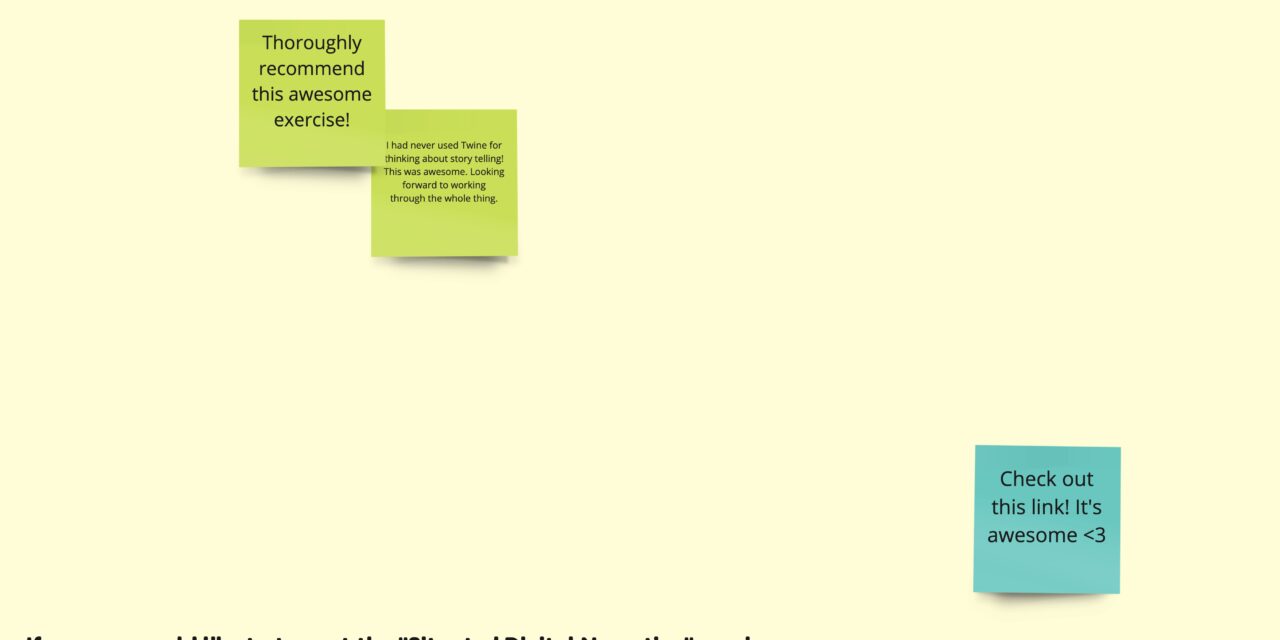
An eventual learning was that I designed the session for silence: the participants worked through the steps quietly on the Zoom call. When the silence got too loud for me, I checked in. Few participants asked me questions and I troubleshooted. It helped that I even received some feedback in the symposium’s Miro board, which is the image at the top.
The Feminist HCI symposium brought together those interested in feminist Human-Computer Interaction (HCI) and gender-related digital technologies to discuss questions of feminisms and technologies. Going online meant that this was now accessible to a lot more people.
This symposium was put together by
- Professor Claude Draude. She leads the Gender/Diversity in Informatics Systems(GeDIS) atUniversity of Kassel, Germany.She works with approaches from intersectional feminist STS, critical theory, new materialism, arts and design in computing.
- Nana Kesewaa Dankwa is currently a PhD candidate in Computer Science at the University of Kassel. She is currently working on the INTeGER project and has major interests in exploring participatory approaches that empower users and tackles the embodiment of oppression and marginalization in tech.
- Dr. Angelika Strohmayeri s a senior lecturer and co-director of the newly established Design Feminisms Research Group at Northumbria University’s School of Design. She is the co-leader of fempower.tech, a feminist technology collective aiming to raise awareness of, and improve experiences by people who are made marginal in HCI and technology research more widely.
- Dr Rosanna Bellini is researching how we built moral responsibility into digital tools that encourage perpetrators of domestic violence to desist from abusive behaviours.