
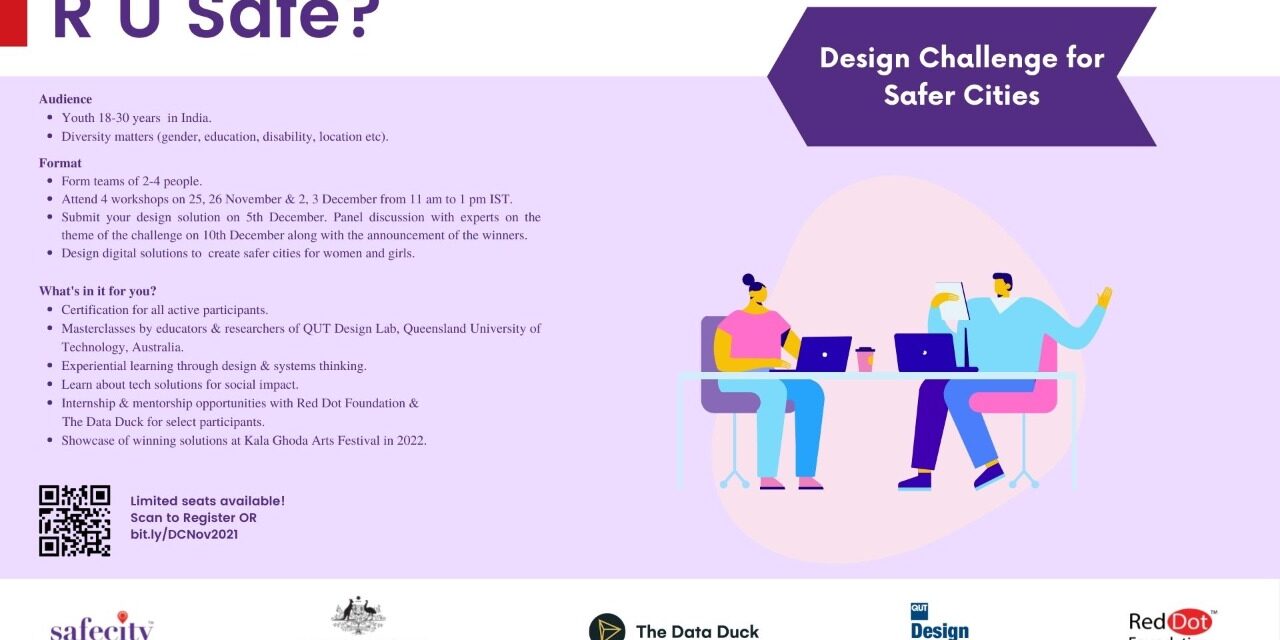
One of my favourite things is to utilise creative and experiential experiences to work with young people towards social change. The “R U Safe? Design Challenge for Safer Cities” was one such challenges which held during the 16 days of activism against gender violence. A collaboration between QUT Design Lab, Safecity/RDF, Data Duck and the Australian Consulate of Mumbai, we posed the question “How might we engage people who are otherwise disengaged to make cities safer / reduce street harassment?”
The goal was to work with young people to figure out design solutions to encourage safe bystander intervention. The outcome of the five day program was a series of videos designed to move community members and passers-by towards action in cases of gender-based violence. Following is the schedule of design challenge along with YouTube videos.
25th November Workshop 1: Defining the Problem and setting the context
| 11:00am-11:45am IST | Introduction to the Design Challenge by RDF/QUT/TDD
|
| 11:45am-12:15pm IST | Gender-sensitive tech and design for behavioural nudges, Ritu David, The Data Duck |
| 12:15pm-01:00pm IST | Design sprint (RDF/ TDD/QUT):
|
Expected outcome: Teams are introduced to the chosen problem and provided examples of possible interventions. Teams should also have their team charter complete.
26th November Workshop 2: Masterclasses on tech, community design and social impact with Prof Marcus Foth and Assoc Prof Glenda Caldwell
| 11:00am-11:45am IST (lecture)11:45 am -12:00pm IST (Q&A) | Masterclass with Prof. Marcus Foth & Assoc. Prof. Glenda Amayo CaldwellThe Right to the Digital City Revisited: From Street-level Activism to Amplifying Planetary Voices
In this talk, Professor Marcus & Associate Professor Glenda will discuss case studies and examples from around the world that illustrate the diversity of technology supported community activism. They will discuss the role that urban interaction design, situated community engagement, and grassroots activism can play in the quest to bring about genuine participation and agency, social justice, and more-than-human futures. |
| 12:00pm-12:45pm IST(lecture)
12:45pm -01:00pm IST (Q&A) |
Masterclass with Assoc. Prof. Jackie Kauli & Assoc. Prof. Verena ThomasCo-Creative Approaches for empathy and collective action to address GBV
In this session, Assoc. Prof. Jackie and Assoc. Prof. Verena share how they work with creative processes to build empathy and collective action to address gender-based violence in Papua New Guinea. Participants will experience a number of creative tools to explore character-based scenarios to reflect on the impact of violence on individuals and communities and to identify possible solutions from within. A particular focus of this session will be how these creative tools can be used to create a safe space to understand context and to generate collective action to address GBV. |
Expected outcome: Teams identify their chosen problem and clarify their doubts.
2nd December Workshop 3: Crafting the message and choosing the media for communication
| 11:00am-11:45am IST | Storytelling, Community Participation & Technology
|
| 11:45am-01:00pm IST | Design sprint (RDF/ TDD/QUT):
|
Expected outcome: Teams brainstorm ideas/interventions for identified problems.
3rd December Workshop 4: Generating empathy and a call to action
| 11:00am-11:45am IST | How to express your intervention in video
|
| 11:45am-01:00pm IST | Design Sprint (RDF/ TDD/QUT):
|
Expected outcome: 1st iteration of team intervention
5th December: Submission of digital artefacts for the Jury selection
10th December Final event: Panel discussion and final winners announced.